
What is RDEC and ERIS?
RDEC is a UK tax relief scheme for businesses that carry out research and development (R&D). It is intended to compensate businesses that make investments in developing new goods, services, procedures, or technologies or in enhancing those that already exist. A business may be eligible for a tax credit from HMRC if it incurs qualifying R&D expenses. A UK tax relief program called RDEC assists businesses in recovering a portion of their R&D expenses. In certain situations, this can result in a cash payment or a reduction in the corporate tax that the business must pay.
For small and medium-sized enterprises that spend a sizable amount of their expenses to research and development, the UK offers the ERIS tax relief scheme. It targets businesses that are losing money but have a strong emphasis on innovation, such as creating new goods, services, or technologies. The program helps these companies improve cash flow while continuing to participate in R&D operations by offering a higher level of tax support than ordinary R&D relief. taxable income taxable income taxable income
Understanding the Difference Between ERIS and RDEC:
It is essential to understand the core difference between the two schemes before considering how to account for them:
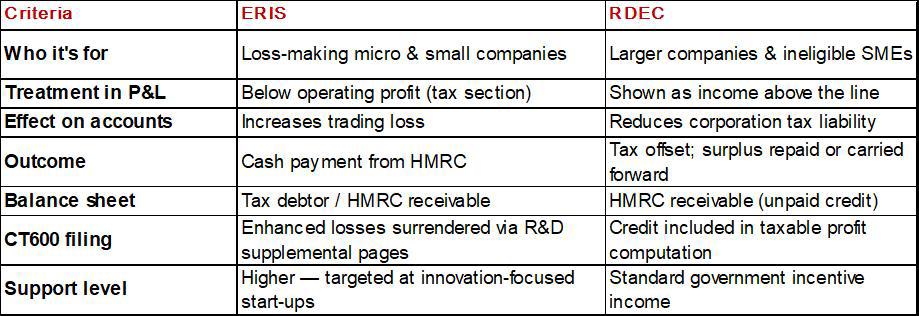
- ERIS (Enhanced Research and development Intensive Support) is targeted at loss-making micro and small companies. It allows you to enhance your R&D losses and then surrender those losses in exchange for a cash payment from HMRC.
- In contrast, RDEC (Research and Development Expenditure Credit) is handled more like a government incentive income. It primarily affects larger businesses or SMEs (Small medium enterprises) that aren't eligible for ERIS. It appears as taxable revenue in your accounts and is utilised to lower your corporate tax rather than raising losses.
Even though they both create financial gains, they are documented in different ways.
 tax return tax return tax return tax return
How ERIS is reflected within your accounts:
The most important thing to keep in mind while accounting for ERIS is that it is not accounted for within your profit and loss statement as sales or trading income. Your R&D spending are still reported as expenses in the standard way. Yet, the tax benefit produced by ERIS is handled in the tax section, underneath the operating profit line. To break it down further, ERIS expenditure increases your annual trading loss. After that, the greater loss can be turned over to HMRC in return for a tax credit. If HMRC owes you money, it will appear as a positive tax in your profit and loss and a tax debtor/ HMRC receivable on your balance sheet.
How RDEC is Reflected in Your Accounts:
Since RDEC is considered a taxable income, it is handled substantially differently.
The RDEC credit appears as income in your profit and loss account. The credit is therefore applied to lower your corporation tax amount. The remaining amount may be carried forward or reimbursed to you by HMRC if the credit exceeds your tax amount. Any unpaid credit is shown as a debtor on your balance sheet and is typically referred to as "HMRC receivable". tax relief tax relief tax relief tax relief tax relief tax relief
How to Report ERIS and RDEC in Your CT600:
Each scheme is treated differently when filing your corporation tax return. You will enhance your R&D losses by using ERIS to modify your tax computation. After that, these losses are turned in for a financial reimbursement, which is requested through the appropriate R&D supplemental pages (CT600L). This leads to either a direct cash return from HMRC for ERIS. For RDEC this can lead to either a direct cash return from HMRC or a decrease in the amount of tax due. The credit is included in the computation of your taxable profits when you use RDEC. After that, it is deducted from your corporation tax obligation. Depending on the status of your business, any excess credit may be carried over or repaid. taxable income taxable income taxable income taxable income
Common Mistakes to Avoid:
Treating both schemes identically in the accounts is one of the most frequent mistakes. RDEC should never be viewed just as a tax refund without being included in profit, and ERIS should never be displayed as turnover or sales. Additionally, since HMRC will reconcile the two sets of data, it is crucial that the numbers in your accounts and your CT600 submission match.
In conclusion:
Both ERIS and RDEC can offer businesses involved with innovation significant financial support, but they must be properly documented and compliant with HMRC regulations. RDEC is displayed as income and then used to balance corporation tax, whereas ERIS cuts tax through improved losses and frequently resulting in a cash repayment. If you handle this correctly, your accounts will be accurate, your tax return will be proper, and your claim will be handled quickly.